Home / Tutorials / QFD Tutorial
QFD Tutorial
This tutorial covers Quality Function Deployment (QFD) including creating Pairwise Comparison Matrices (PCM) and Houses of Quality (HOQ).
Contents
- Creating QFD System
- Using Wizard to Control QFD
- Using Wizard to Create PCM
- Using Wizard to Create First HOQ
- Using Wizard to Create Other HOQs
- How to Pareto PCM
- How to Edit PCM
- How to Create HOQ
- How to Edit HOQ
- How to Pareto HOQ
Creating QFD System
The QFD system is built from one Pairwise Comparison Matrix (PCM) and four Houses of Quality (HOQ). After selecting the appropriate menu option, the Quantum XL application will prepare the matrix for data input in a new worksheet.
The QFD system can be created in two ways:
- Using the wizard (recommended)
- Manual creation
Using Wizard to Control QFD
- Step 1: Use Wizard to Create PCM
- Step 2: Use Wizard to Create First HOQ
- Step 3: Use Wizard to Create HOQ2 to HOQ4
Using Wizard to Create PCM
Step 1: From the Stat Tools Tab, select the option QFD Wizard > Start Wizard.
Step 2: The Wizard Dialog will pop up. Enter the number of customer requirements in the box provided.
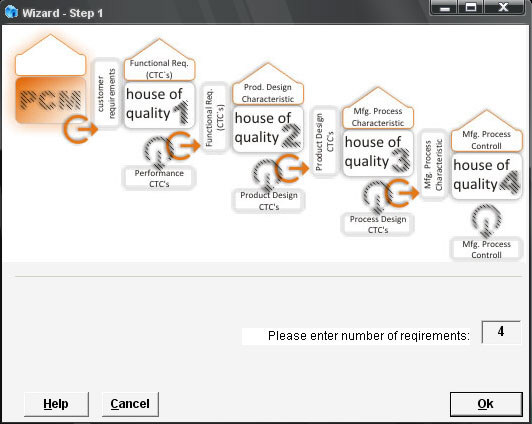
Step 3: Press Ok.
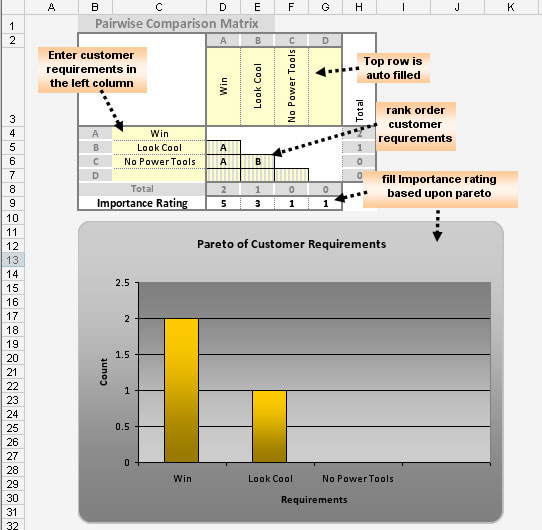
The wizard will create a new worksheet labeled "PCM 1". The new worksheet contains an empty pairwise comparison matrix (PCM). The left column and top row represent customer requirements. The left column is used for entering customer requirements. The top row will be automatically filled.
Step 4: Enter customer requirements in the left column.
Step 5: Rank order customer requirements.
Step 6: From the Excel menu bar, select Stat Tools Tab > Pairwise > Pareto Pairwise.
Step 7: If you want to override automatic ratings, you can use the Pareto chart to fill the importance rating row.
Following is an example of creating a PCM for a pinewood derby race car.
Using Wizard to Create First HOQ
The second step in creating the QFD system is creating the first HOQ.
Step 1: From the QXL Stat Tools Tab, select the option QFD Wizard > Next Step.
Step 2: The Wizard Dialog for step two will pop up. Enter the number of rows (customer requirements) and number of columns (Characteristics Critical to Quality - CTQ). The default number of rows is the Number of Requirements from the prior PCM + 5. The default number of CTQs is the Number of Requirements * 1.5. This allows growth.
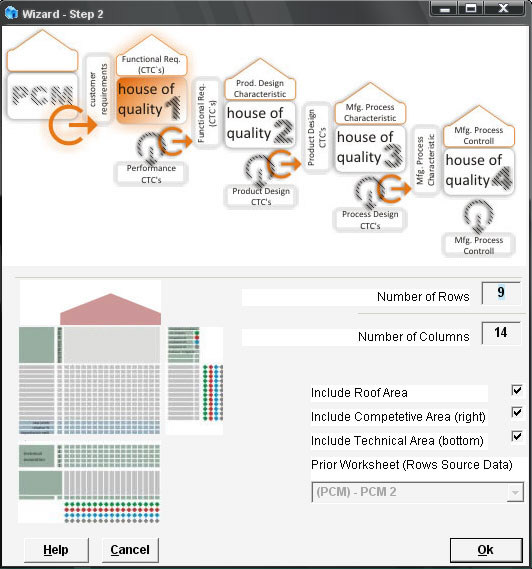
Step 3: Press Ok.
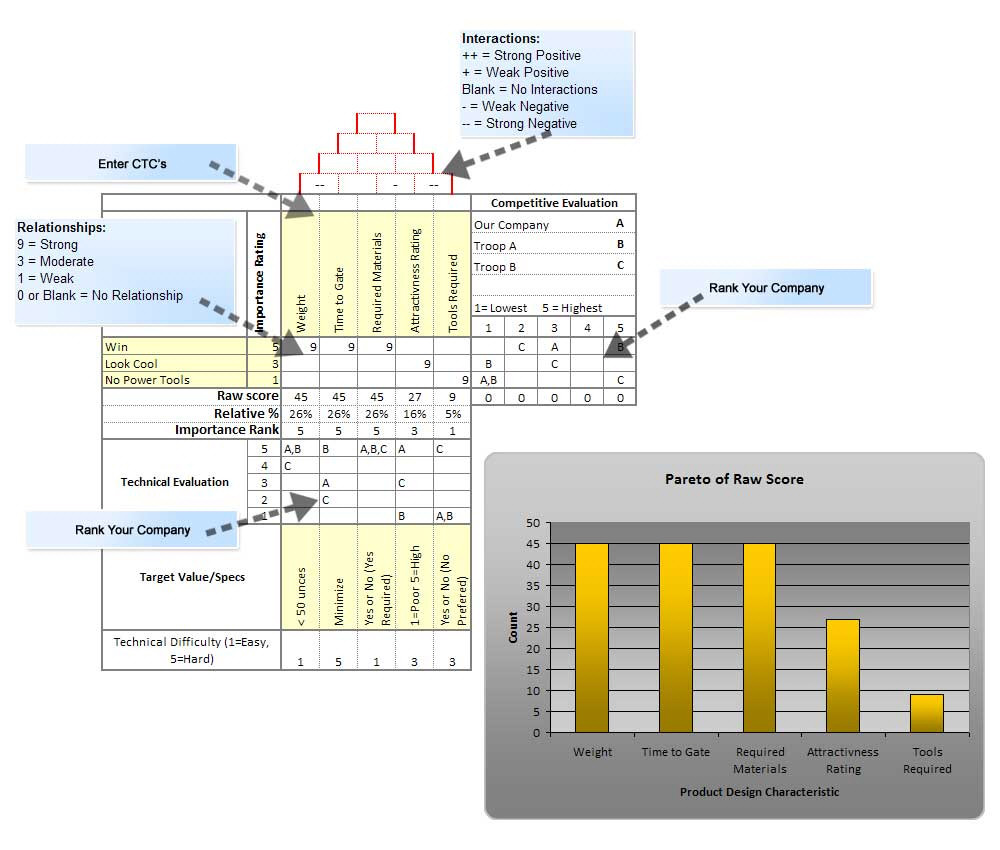
The Wizard will create a new worksheet, labeled with "HOQ 1-1". The new worksheet contains the HOQ. The main parts of the HOQ are identified on the following picture:
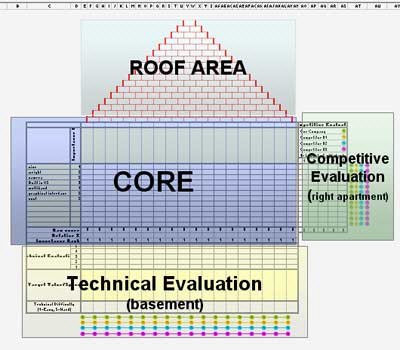
The left side of the CORE area is the customer requirements, while the top row represents Characteristics Critical to Quality (CTQ). Customer requirements and importance rating columns are automatically copied from the previous PCM.
Step 4: Enter CTQs in the top row.
Step 5: Fill in the relationships in the central part of the Core area by entering the relationship value in the cell where relationships exists between the customer requirement and CTQ.
Step 6: Fill the correlations between CTQs in the roof area. The correlations go from strong negative to strong positive.
Step 7: Fill the Competitive Evaluation Area. Rank your company vs. the competition.
Step 8: Fill the Technical Evaluation Area. Enter the targeted value for each CTQ, and how technically difficult it is to achieve that value. Rank your company vs. the competition.
Step 9: Pareto HOQ. From the QXL Stat Tools Tab, select the option QFD > Pareto HOQ. If you want to override automatic ratings, you can use the Pareto chart to fill the Importance Rank row. It will be used for the next HOQ.
Following is an example of creating the first HOQ for a pinewood derby race car.
Using Wizard to Create Other HOQs
Step 1: From the Stat Tools Tab menu, select the option QFD Wizard > Next Step.
Step 2: The Wizard Dialog for step three will pop up. Enter the number of rows (Characteristics Critical to Quality - CTQs) and number of columns (Product Design Characteristics). The default number of rows is the Number of CTQs from the prior HOQ + 5. The default number of Product Design Characteristics is the Number of CTQs * 1.5. This allows growth.
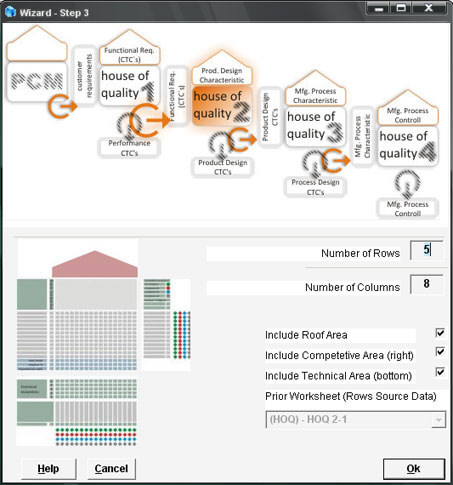
Step 3: Press Ok. The Wizard will create a new worksheet labeled "HOQ 1-2".
The following steps are very similar to the steps in Using Wizard to Create first HOQ.
Step 4: Enter the Product Design Characteristics in the top row.
Step 5: Fill in the relationships in the central part of the Core area by entering the relationship value in the cell where relationships exists between the CTQ and Product Design Characteristics.
Step 6: In the roof area, fill in the correlations between Product Design Characteristics. Correlations go from strong negative to strong positive.
Step 7: Fill the Competitive Evaluation Area. Rank your company vs. the competition.
Step 8: Fill the Technical Evaluation Area. Enter the targeted value for each Product Design Characteristic, and how technically difficult it is to achieve that value. Rank your company.
Step 9: Pareto HOQ. From the Stat Tools Tab menu, select the option QFD > Pareto HOQ. If you want to override automatic ratings, you can use the Pareto chart to fill the importance rating row. It will be used for the next HOQ.
How to Pareto PCM
Step 1: Activate the sheet that contains the PCM you want to Pareto.
Step 2: From the menu bar, select QXL Stat Tools Tab > Pairwise > Pareto Pairwise.
How to Edit PCM
Step 1: Activate the sheet that contains the PCM you want to modify.
Step 2: Select QXL Stat Tools Tab > Pairwise > Modify Pairwise Matrix... from the menu bar.
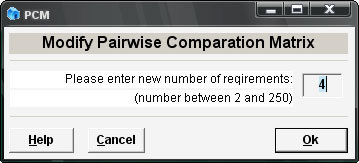
Step 3: Enter a new number of customer requirements.
Note
If the new number is less than the original number of requirements, some data will be truncated. All of the text outside of the PCM will remain intact.
Step 4: Press Ok.
The PCM will be modified to show the new number of customer requirements.
How to Create HOQ
Step 1: Activate the sheet that you want to be prior to the newly created HOQ. If the sheet is blank, the new HOQ will not have any prior sheet. The prior sheet can be either a PCM or another HOQ.
Step 2: From the menu bar select QXL Stat Tools Tab > QFD > Create new HOQ.
Step 3: Enter the number of rows (customer requirements) and number of columns (Characteristics Critical to Quality - CTQs). The default number of rows is the Number of columns from the prior sheet + 5. The default number of columns is the Number of columns from prior sheet * 1.5. This allows growth.
Step 4: Select the areas that you want to be displayed on the sheet.
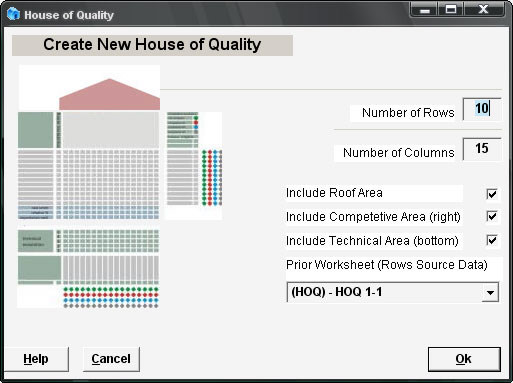
Step 5: Press Ok.
The Wizard will create a new worksheet. The new worksheet contains the HOQ. The main parts of the HOQ are identified on the following picture:
The following description is for the first HOQ. Other HOQs behave the same, only the column and row labels are different.
The left side of the CORE area is the customer requirements, while the top row represents Characteristics Critical to Quality (CTQ). Customer requirements and the importance rating column are automatically copied from the previous sheet.
Step 6: Enter CTQs in the top row.
Step 7: Fill in the relationships in the central part of Core area by entering the relationship value in the cell where the relationship exists between customer requirement and CTQ.
Step 8: Fill in the correlations between CTQs in the roof area. Correlations go from strong negative to strong positive.
Step 9: Fill the Competitive Evaluation Area. Rank your company vs. the competition.
Step 10: Fill in the Technical Evaluation Area. Enter the targeted value for each CTQ, and how technically difficult it is to achieve that value. Rank your company.
Step 11: Pareto HOQ. From the QXL Stat Tools Tab, select the option QFD > Pareto HOQ. If you want to override automatic ratings, you can use the Pareto chart to fill the importance rating row. It will be used for the next HOQ.
Following is an example of creating the first HOQ for a pinewood derby race car.
How to Edit HOQ
Step 1: Activate the sheet that contains the HOQ you want to modify.
Step 2: From the menu bar select QXL Stat Tools Tab > QFD > Modify HOQ.
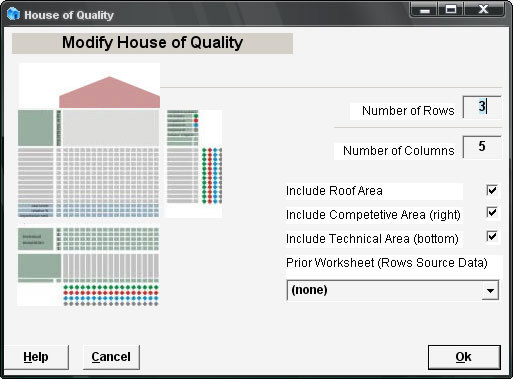
Step 3: Enter new number of rows and/or columns.
Step 4: Select the areas you want to be displayed.
Note
If the number of columns or rows is less than the original number, some data must be truncated. However, any data outside the HOQ is preserved.
Step 5: Press Ok.
The HOQ will be modified to reflect the new number of rows and/or columns.
How to Pareto HOQ
Step 1: Activate the sheet that contains the HOQ you want to Pareto.
Step 2: From the Excel menu bar, QXL Stat Tools Tab > QFD > Pareto HOQ.