Home / Statistical Tools / Analysis Tools / Time Series / Double Exponentially Weighted Moving Average (Double EWMA)
Double Exponentially Weighted Moving Average (Double EWMA)
From Excel click...
QXL Stat Tools Tab > Analysis Tools > Time Series > Double Exponentially Weighted Moving Average
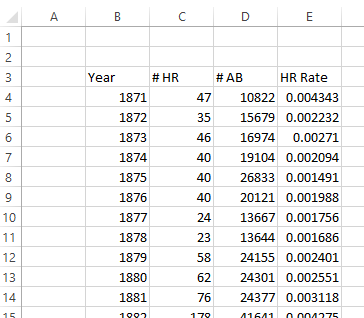
The double exponentially weighted moving average (Double EWMA) chart will smooth your data by calculating the double exponentially weighted moving average. The moving average chart is typically not used with seasonal data. The example below uses the Home Run Rate from Major League Baseball. You can download this dataset here. This dataset has the Home Run rate from 1871 to 2013. The Home Run Rate is calculated as the number of home runs divided by the number of at bats. For help interpreting the chart, see Understanding the Exponentially Weighted Moving Average Chart.
Step #1: Select data source for Analysis.
The first few rows of the dataset are below.
Step #2
From Excel click...
QXL Stat Tools Tab > Analysis Tools > Time Series > Double Exponentially Weighted Moving Average
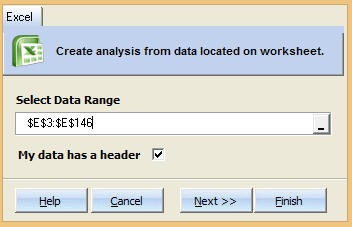
Step 3: Select the data range which contains your data.
Step 4: Choose Model Type and Forecast Units.
Alpha parameter (Level): Choose the level weight for the EWMA analysis. For more information about weight, see Understanding the EWMA.
Gamma parameter (Trend): Choose the trend weight for the EWMA analysis. For more information about weight, see Understanding the EWMA.
Step 5: Press Finish. Quantum XL will complete the analysis.
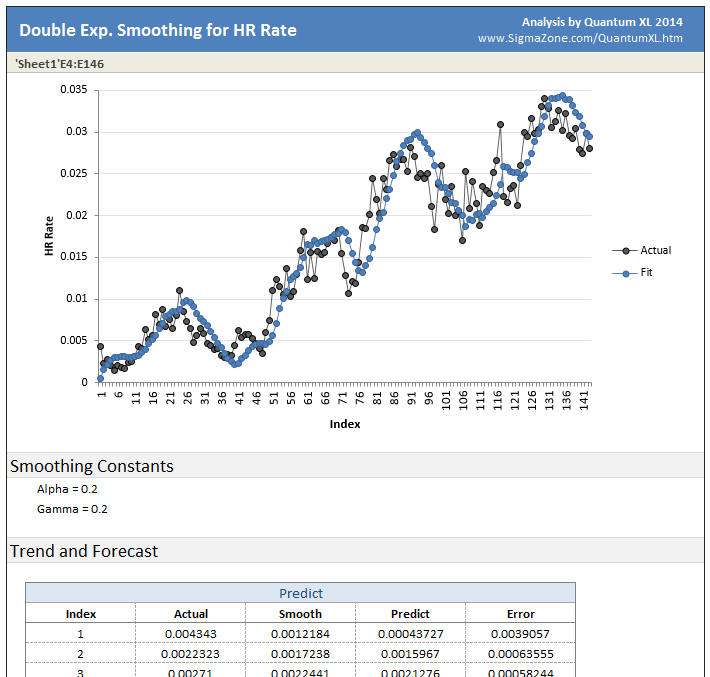
Plot Area: Quantum XL will plot the "Actual" series which represents the original data (without averaging). The "Fit" series represents the data smoothed by averaging the data.
Smoothing Constants: Quantum XL will display the alpha and gamma values.
Trend and Forecast: For each data point, Quantum XL will provide the actual value, predicted, and the error in the prediction.
See Also
The data used in the article comes from www.seanlahman.com.