Home / Statistical Tools / QFD, FMEA, & Pugh / Pugh / Overview
Overview
Pugh Concept selection and generation was invented by Stuart Pugh. The Pugh Matrix is a decision making tool that helps determine which items or solutions are more important or better than others. Several alternatives are evaluated according to their strengths and weaknesses against a base concept. You can also use the Pugh Matrix to help generate new design alternatives that combine the current alternatives into a new hybrid design that includes the best of the best.
Basic steps of concept selection:
Step 1: Determine the decision criteria and collect alternatives. Decision criteria are the attributes of the design or process that the alternatives will be compared against. For example, if you were using Pugh to help you choose a vacation location, your decision criteria might include vacation cost, travel time, and a fun rating. The alternatives are the different options or designs that can be used to meet the decision criteria. Select one of the alternatives as the "Baseline". The baseline is typically the favorite alternative or the alternative that is currently being used.
Step 2: Create the Pugh Matrix using Quantum XL. The Pugh Matrix will be added to the active workbook in Microsoft Excel.
Step 3: Enter the decision criteria. It is often desirable to gather the decision criteria in groups. For example, product design decision criteria might be grouped by "Quality", "Cost", and "Schedule".
Step 4: Enter the weights for each decision criteria.
Step 5: Compare each of the alternatives to the baseline concept using the following guide:
- +3 = Far Better than Baseline
- +2 = Much Better than Baseline
- +1 = Better than Baseline
- 0 = Same as Baseline
- -1 = Worse than Baseline
- -2 = Much Worse than Baseline
- -3 = Far Worse than Baseline
Step 6: Try to create new alternatives using the best of the best.
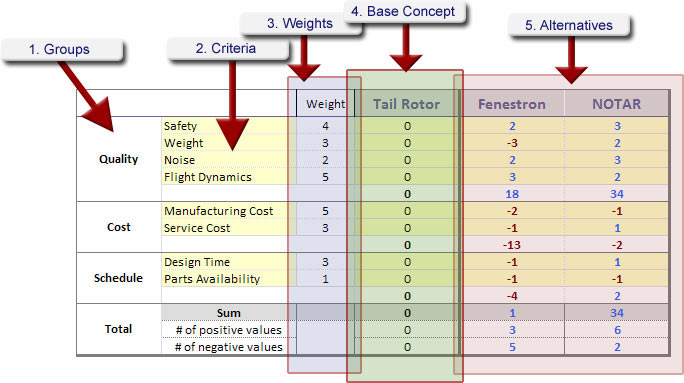
Definitions:
-
Groups: Decision criteria are grouped logically into sections.
-
Decision Criteria: List of weighted criteria against which each Alternative is evaluated.
-
Weights: Relative weights of each criterion. Typically a scale of 1 through 5 is used, with 5 being most important and 1 being least important.
-
Baseline concept: The favorite or current concept. All other alternatives are evaluated against this concept.
-
Alternatives: A list of different concepts that are competing with the baseline and other alternatives.