Home / Statistical Tools / Additional Tools / Problem Solving / Component Swapping
Component Swapping
From Excel click...
QXL Stat Tools Tab > Problem Solving > Component Swapping
Component Swapping is a process used during divide and conquer to rapidly determine if a branch contains the root cause(s). It involves changing components between a Best of Best (BOB) and a Worst of Worst (WOW) system.
If moving a component from the WOW to the BOB results in degraded performance, then that component likely contains a root cause.
Step #1: Select a BOB and WOW.
Select them from available systems. The further apart the BOB and WOW are, the easier it will be to detect the component with the root cause(s).
Create a Component Swapping template. (Quantum XL > Problem Solving > Component Swapping > Component Swapping Template)
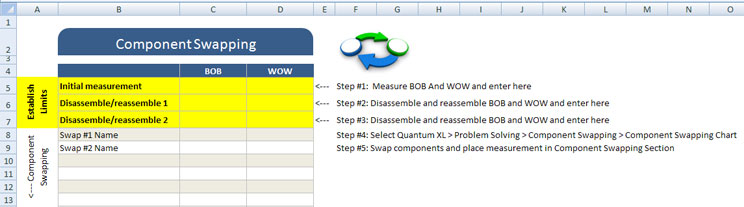
Step #2: Measure the BOB and WOW
Measure BOB and WOW. If possible, disassemble and reassemble the BOB and WOW three times (do not swap components yet). Enter measured data into the template.
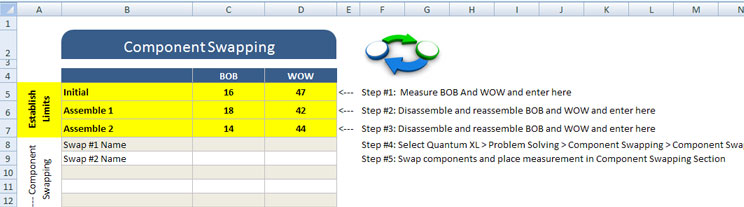
Step #3: Determine if BOB and WOW are different enough.
For component swapping to work, there must be a significant difference between BOB and WOW.
- Find D, the difference in median:
- Calculate the median of each measurement.
- Calculate D = Difference between MedianBOB and MedianWOW.
-
Find R-bar, the average range. Rbar = ((MAX(BOB) - MIN(BOB)) + (MAX(WOW) - MIN(WOW))) / 2
-
Difference Ratio = D / Rbar
If the Difference Ratio is not greater than 1.25, then:
-
The difference is in the assembly process.
-
The difference (D) is not sufficient. Find a bigger difference between BOB and WOW.
-
There is too much variation in the measurement system.
If the Difference Ratio is greater than 1.25, then proceed with Step #4.
Step #4: Create a Component Swapping chart.
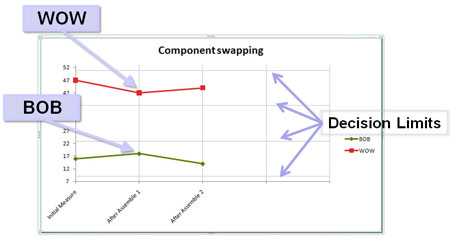
Go to Quantum XL > Problem Solving > Component Swapping > Component Swapping Chart, to add chart to a template sheet. Chart shows BOB and WOW data and Decision Limits.
Decision Limit (DL) = Median ± (t.95 * Rbar / d2), where
t.95 = TINV (1 - 0.95, COUNT(BOB) + COUNT(WOW) - 2)
d2 is a math constant = 1.693
Step #5: Swap Components
Swap components, record results and check the plot.
- Possibility #1: No Change. The BOB stays good and the WOW stays bad (within the decision limits). Meaning: The swapped component is not the root cause.
- Possibility #2: Reversal. The BOB becomes a WOW and the WOW becomes a BOB. Meaning: The swapped component is likely the sole root cause.
- Possibility #3: Partial Change. The BOB or WOW moves out of their decision limits. Meaning: The swapped component is part of the root cause, but others might still exist.