Home / Statistical Tools / Reliability / Censored / Reliability: Understanding Censored Data
Reliability: Understanding Censored Data
When analyzing time to failure data, the failure time for an observation is unknown. For example, you put 100 units on life test for a maximum of 100 days. If the test is terminated on schedule, then any units still functioning after 100 days are said to be Right Censored. Some users will ignore the units that are still functioning and only analyze the failed units; however, a better way is to treat the units still functioning as censored data.
Censoring can occur in three different ways...
Left Censoring
The unit failed after it was put on life test, but before the first inspection. Example: You put 100 units on life test and choose to sample them once per week. During the first inspection, you find 2 failures. The two units are Left Censored in that you know they failed before the first week but not the exact time.
Interval Censored
The unit failed at some time interval but the exact time is not known. Example: You put 100 units on life test and choose to sample them once per week. Between the 5th and 6th week, 7 units fail. These 7 units are Interval Censored in that you don't know the exact time of failure, only that it occurred between the 5th and 6th week.
Right Censored
The unit didn't fail during the life test. Example: You put 100 units on life test for 1 year. At the end of one year, the test is terminated. Any units still functioning at the end of the year are right censored.
Left, Interval, and Right Censored Data Used in Conjunction
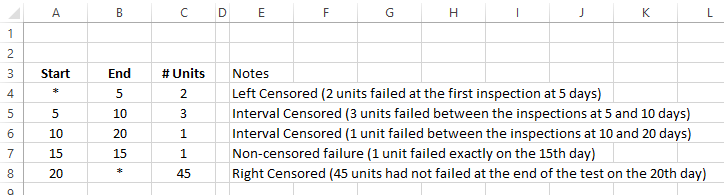
It is quite common for testing to involve all three types of censoring. In the example below, 52 units were put on life test and inspected every 5th day. Before the first inspection, two units failed (left censored). Three more units were discovered defective on the second inspection. Since these three units were known to be functioning on day 5 (first inspection) then these units are Interval Censored. On the 15th day, the experimenter happen to be in the room when one of the units failed. Since he observed the exact time of failure, this unit is non-censored. Finally, the test was terminated after 20 days. The remaining 45 units are Right Censored.
Type I and Type II Censoring
Many text books delineate between Type I and Type II censoring. While this distinction is important in reliability planning, it doesn't affect the fitting of the model. Therefore, Quantum XL doesn't ask about Type I and Type II censoring.
Type I Censoring
The experiment stops at a predetermined time. For example: you choose to put 100 units on test for one year. At the end of the year, the test is terminated and all units that are still functioning are Type I Right Censored. The delineation of Type I is due to the termination of the experiment based ontime (one year).
Type II Censoring
The experiment stops at a predetermined number of failures. For example: you choose to put 100 units on life test until 50 of them fail. Once 50 fail, the remaining 50 are said to be Type II Right Censored.
Finally, it should be noted that not all reliability data is censored. In many tests, the exact time of failure is known. This is called Uncensored or Exact Failure Time data.